
Your energy bills are too high. But slogans alone won't bring them down.
That's why today, the Conservatives have published the most detailed energy analysis ever produced in British politics.
Because if we are going to build a serious alternative to Labour's failing Net Zero plans, we need to do the serious work first.
Click here to watch Shadow Energy Secretary Claire Coutinho explain more.
The findings of this report are stark.
Experts have found that if we scrap Net Zero and focus on making electricity cheap instead, we could save over £320 billion on electricity bills by 2050.
That’s the equivalent of around £540 per household, every year, for the next two decades.
But if we continue with Labour’s Net Zero plans, our energy bills will continue to go up.
Click here to read the full report.
This isn’t about abandoning cleaner energy either. It isn't about denying climate change.
Under this system, the electricity system would still be nearly 80% clean, with more nuclear, renewables and reliable gas.
This is about building an alternative that doesn’t leave hardworking families across the country picking up the bill.
Labour's Net Zero obsession means higher prices and higher emissions. Meanwhile, Reform are all slogan and no detail.
Only the Conservatives are putting in the serious work to bring your bills down.
And watch below our press conference today on the hidden costs of Net Zero 👇:
You can read Claire's full speech below 👇:
Countries around the world have proven over and over again that the two most important drivers of growth are cheap, abundant energy and economic freedom.
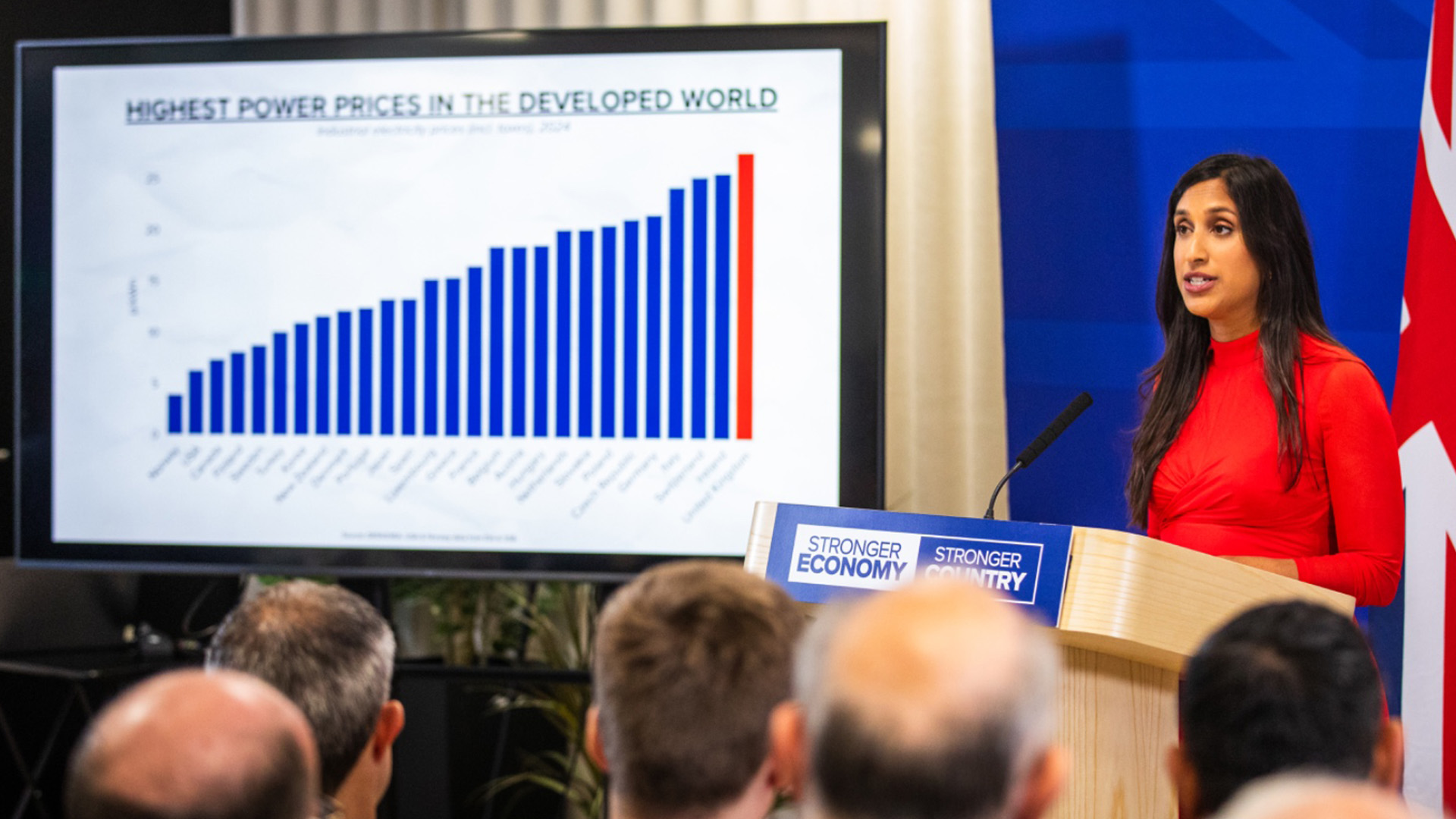
That is why one of the biggest economic problems we face in Britain today is that we have the highest electricity prices in the developed world.
There is simply no such thing as a high-growth, low-energy country.
As our electricity has got cleaner, it has also got more expensive.
That means we are using less of it, just as the rest of the world is using more.
Our expensive electricity is pushing our industry overseas, it is harming our ambitions in AI, and it is hurting living standards.
These things are widely acknowledged.
But what people do not admit is that expensive electricity is bad for the environment too.
Over the summer, climate policy has been in the news.
It has been said by some that we are in denial.
We Conservatives are not in denial about climate change.
It is the Left who are in denial about the fact that climate policy is failing.
Look at where our emissions actually come from now.
Just 10% of our emissions come from our electricity grid.
But 90% come from transport, heating and elsewhere in the economy.
There is simply no point having the cleanest electricity in the world if nobody in Britain can afford to use it.
If you want to cut emissions, then you need people to want electric cars and electric heating, and for that, your number one priority should be to make electricity cheap.
But Net Zero legislation has forced us to do the opposite.
In fact, Ed Miliband’s Clean Power 2030 target is intent on squeezing every last drop of carbon out of our electricity, no matter the cost.
But making electricity expensive puts electrification out of reach for ordinary families.
It is moving our industry to more polluting countries overseas, forcing us to import back those same goods with higher emissions.
That is not improving the climate.
It is madness, especially when electrification is a far bigger prize than perfectly clean electricity when it comes to reducing emissions.
There are some who will say that the cost is worth it because it gives us ‘climate leadership’.
But our high electricity prices are not convincing any other country to follow our lead.
In fact, it is our hot and heavy pursuit of Net Zero, ignoring all of its costs, that is giving others the ick.
The difference between us and other parties is that we want our climate policy to work for the economy and the environment.
That is why we are the only party to call for the measurement of the offshoring of emissions.
That is why we think the best way to help people adopt clean tech is not endless bans and mandates and subsidies, but to make it work for consumers.
Rather than forcing people to do what we want, our job as politicians should be to lift the barriers in their way.
That is why we believe we should focus all our attention on making electricity cheap, and then let consumer choice be king.
That is the only approach that will work in the long term.
That is why, for the economy or for the environment, cheap electricity is the holy grail.
But first, let me explain how we got here.
Back in 2023, I had just been appointed Energy Secretary in the last Conservative Government.
A few weeks in, I asked civil servants what I thought was a simple question.
Prove to me that renewables are cheap.
Like all of you, I had heard people saying that for years.
But to my astonishment, they could not prove it.
Our entire energy policy was based on the promise that all this wind and solar was going to cut bills, and yet when I combed through the spreadsheets put in front of me, I realised that the evidence was not there to back it up.
The truth is, too much wind and solar creates all of these extra hidden costs.
It is like a Ryanair flight.
The ticket might look cheap, but once you have paid for a bag, a seat and a sandwich, you realise you have been stung.
We are going to pay billions to switch wind farms off when it is too windy, billions for expensive backup when it is not windy enough.
Tens of billions for the hundreds of miles of extra pylons needed to connect all of these extra panels and turbines into the grid.
Cost after cost after cost.
And all of it is landing on people’s energy bills.
So, I asked the Department to get to work and do a proper analysis of these extra costs, but then we had an election and Ed Miliband cancelled that work.
Either he did not want to know the truth, or he did not care.
The truth is, Labour’s £300 energy bills promise was only ever a number to get them through the election trail.
And far from bills going down by £300, since the election, bills have gone up by £300 instead.
Which brings me to why we are here today.
For me, this is unfinished business and why I asked Kemi if I could stay in the Energy brief after the election.
Two years after Ed Miliband cancelled the true costing of renewables that I started, Onward have stepped in to finish the job.
This is the single most detailed costing of the electricity system that has been produced in British politics.
The findings are remarkable.
It shows we can save consumers over £320 billion on their electricity bills by 2050 if we prioritise cheap electricity over a Net Zero grid dominated by wind and solar.
And we would still have electricity which is nearly 80% clean at the end of it.
That is the equivalent of savings of £540 per British household, per year, for the next two decades.
This is the work that should have been done by Government but has not been because they are more driven by ideology than evidence.
I want to thank the author, Ed Hezlet, who is one of the most remarkable minds emerging in energy policy today, and Marlon Dey and his team at Transira Energy for carrying out the extensive modelling behind the report.
The Cheap Power system prioritises cost.
It has a bit more gas, triples our nuclear power, has far fewer wind and solar farms, and gets rid of the Carbon Tax.
So where do the savings come from?
Roughly half the savings come from having to build much less grid.
Fewer pylons and cables carving up the countryside.
The rest of the savings come from lower wholesale prices, lower balancing costs and subsidies.
Basically, we would pay a lot less money to switch wind farms off when it is too windy or for backup when it is not windy enough.
This is important because the Government is currently running another auction round for renewables.
In the last one, Ed Miliband signed up to the highest cost of offshore wind in a decade.
This one is set to be no cheaper.
But to decide whether we should be locking ourselves into these contracts, which last for 20 years, we should know whether or not they are going to make our electricity system cheaper.
The average electricity price so far this year is £97 per megawatt hour.
The Climate Change Committee thinks the cost of offshore wind is £38 per megawatt hour.
The Department for Energy thinks that it is £100 per megawatt hour, but if you actually add up all the extra costs that wind and solar add to the system, then it should be seen as closer to £230 per megawatt hour.
That is eye-wateringly expensive.
If cheap electricity is the holy grail, then we should be doing everything we can to achieve it.
Our Cheap Power Plan, set out last year, would help in the immediate term.
It would cut VAT off energy bills, axe the Carbon Tax and scrap outdated wind subsidies, which could save households £200 immediately.
For the long term, this report shows why we should abolish counterproductive Net Zero legislation pushing us towards more expensive electricity.
We would adopt the Fingleton Review to build nuclear much, much more cheaply.
We would allow for new gas power to keep the lights on.
We would keep zonal pricing on the table if it can cut bills.
We would auction large grid connections to get big users connected quickly.
And we would bring competition into building transmission infrastructure.
But above all, we would rewire energy policy to make electricity cheap again.
The truth is that our problems in energy are a symptom of something wider in our politics.
We have handed more and more of our powers to unaccountable bodies who pay no price for being wrong.
Too much of politics has become more interested in the optics than in doing the hard yards of working out the best route for the country and seeking to persuade.
That is how we end up with Andy Burnham shirking decisions on the North Sea, even though he knows our homegrown gas is much cleaner than importing high-emission gas from abroad.
If civil servants tell politicians that renewables are cheap when they are not, then we are going to make bad decisions.
When the Climate Change Committee gets its costings for offshore wind for the latest Carbon Budget wrong by a factor of 300%, it faces no repercussions.
Ofgem is supposed to be the consumer watchdog, and yet it pays no penalties when bills go up and up and up.
Our grid operator is so reluctant to face the truth that renewables are making our grid unstable that its own control room operators came to me this summer to make their concerns heard.
And on and on it goes.
Our bills are going up and up and up, and nobody seems to be in charge.
We have to bring back pragmatism and accountability to our energy policymaking.
This is not about turning our back on our duty to provide the next generation with a better environment.
The Burkean contract between the living and those yet to be born is a core Conservative principle which we should never abandon.
While the Labour Party will promise you £300 off your bills that they will never deliver, and Reform think repeatedly saying ‘Net Stupid Zero’ is enough of a plan to cut bills, ours is the case for a serious energy policy that works for the climate and the consumer.
I believe Kemi Badenoch is the only political leader in Britain with the courage, the conviction and the intellectual rigour to create the radical overhaul of energy policy that we need.
This much-needed report demonstrates that we can have both economic prosperity and a better environment if we make electricity cheap, let the economy grow and make consumer choice king.
That is the serious choice.
That is the optimistic choice.
And that is what the next Conservative Government will deliver.
Thank you.


