
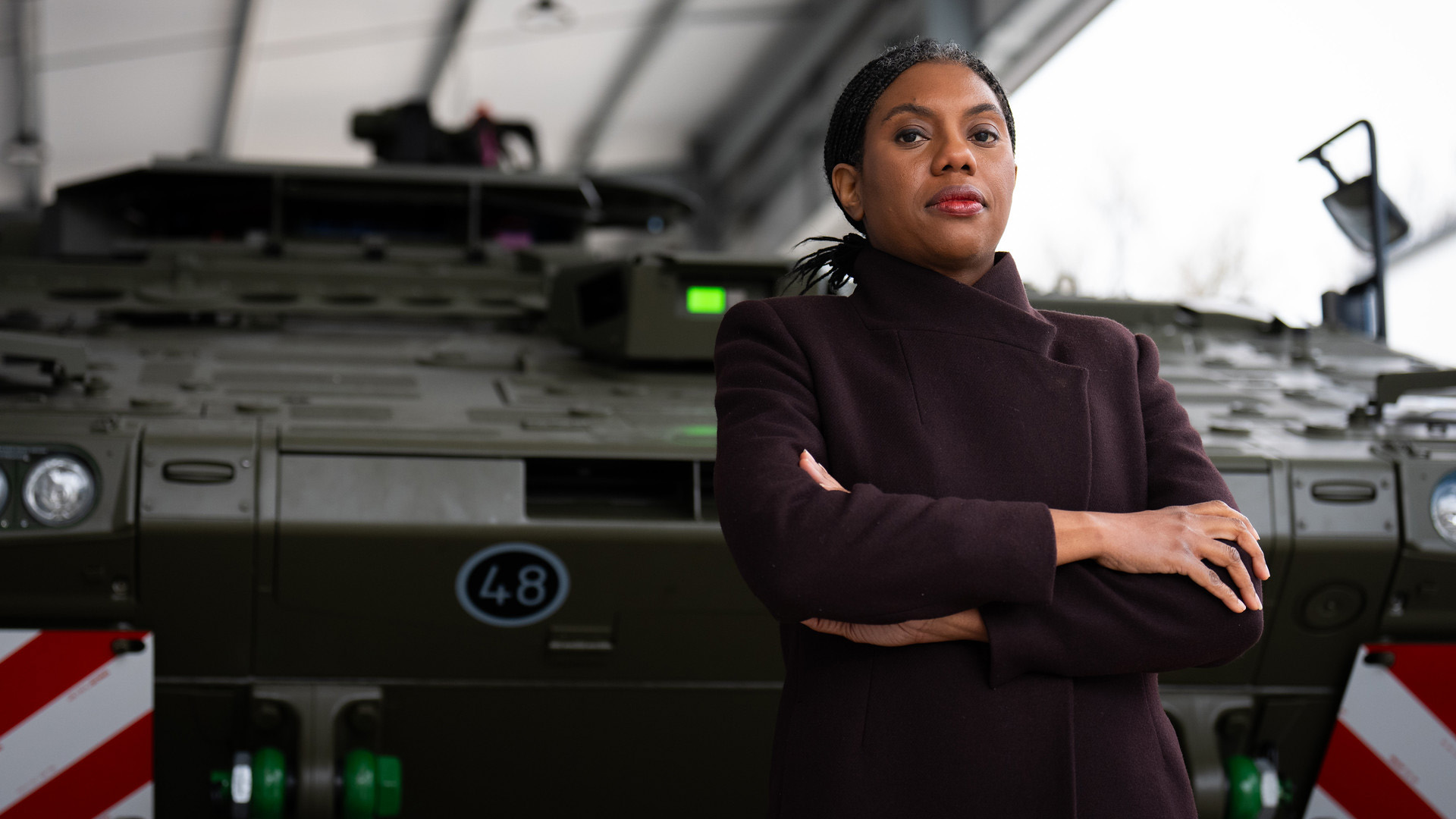
Right now under Labour, our defence spending isn’t anywhere near enough. With war in Europe, we need to be ready to protect ourselves, but we simply aren’t.
Meanwhile their welfare bill is out of control. We can’t afford to protect ourselves because of the cost to keep our current benefits system going.
The Conservatives are clear: we must cut the welfare bill, reprioritise funding from other areas and invest an extra £10 billion a year in our armed forces so we can meet our 3 per cent target to keep Britain safe.
Watch Kemi explain our plan to cut welfare and bolster our defence 👇:
And you can read Kemi's speech below:
Before the summer, Keir Starmer was given intelligence that Russia could launch an attack on NATO as soon as 2030.
Not enough politicians in Parliament have fully appreciated what that means.
By that, of course, I mean Labour politicians.
What this means is that within the next four years, the UK could be at war with the world’s biggest nuclear-armed state.
Because under Article 5, an attack on any NATO country is an attack on all of them.
This week, Germany confirmed that Russia was behind the drone attack at Leipzig airport.
Vladimir Putin has called Britain Russia’s number one enemy.
Russian warships have been sailing through the English Channel, and the undersea cables which power our internet and our entire information and communication network have come under threat.
People may not see it in their day-to-day lives, but hostile states are constantly pushing the boundaries with unconventional warfare.
It is not just Russia.
A cyber-attack that hit Jaguar Land Rover cost our economy more than £1.9 billion.
And over the summer, Iranian hackers managed to shut down a UK power plant.
This is not the plot of a movie.
This is real and it is happening now.
And if things come to a head, all our lives will be changed forever.
National security is not just about tanks, boots on the ground and planes in the air.
It is about our cyber defences, it is about our energy security, it is about our country’s resilience.
National security does not just happen.
We also have to pay for it, and that means spending more money on defence.
Britain’s allies are getting ready for what is to come.
Poland is building an army of 300,000 people.
That is more than triple ours.
Germany has doubled its defence spending in the last five years and is on course to spend 3.5% of GDP by 2035.
Greek warships had to rush to protect our military base in Cyprus, while HMS Dragon was stuck in Portsmouth.
I was in Greece last week and I met their Prime Minister, who told me they are already spending 3.5%.
Being an island might make us feel safer, but it does not prevent conflict from coming to us.
And let us be honest, conflict is coming.
We must act now.
Because the defence of the nation is the first duty of government.
We need to increase our defence spending every year so we can get to 3% of GDP by 2030.
Anything after that is too late.
In the summer, John Healey, then the Defence Secretary, agreed with me.
He resigned because Britain was not on track to spend 3% of GDP on defence by 2030, and I praised him for being a man of principle.
Now that he is Chancellor, he does not seem to believe that anymore, and I am concerned that he has been bought off with a promotion.
I have asked the new Prime Minister three times whether he will meet the 3% target by 2030, and he has not given me an answer.
Three times.
Like Keir Starmer, Andy Burnham is kicking defence spending into the long grass.
I cannot tell you how urgent this is.
Labour’s Strategic Defence Review delayed decisions by a year.
We had to wait another year to hear how they would fund it.
Now we are being asked to wait yet another year to meet their commitments.
Our enemies are not going to sit around until Labour finds the money to fight them.
Russia will attack a country it thinks is weak.
It will not attack a country it knows is strong.
We need to be strong.
If you want peace, you prepare for war.
If the Prime Minister is not ready, willing or even able to do that, and do it now, he should call a general election.
Finding the money to pay for defence means making tough choices.
It means making difficult trade-offs, something Andy Burnham is reluctant to do.
When I became Leader of the Opposition, I said I would set out a plan to get to 3%.
And since our party conference, we have announced our £17 billion Sovereign Defence Fund.
Thank you, James Cartlidge.
And I have already announced that we would reinstate the two-child benefit cap.
Thank you, Helen Whately.
That will pay for the largest net increase in British troop numbers under any Prime Minister since the Second World War.
Well, today I can announce that I am keeping the promise I made.
We have now completed our work to get to 3%.
And today my team have set out our plan to remove housing benefit and remove the VAT exemption for Motability.
Alongside savings from the disastrous Chagos Deal and repurposing money from the British Business Bank into defence, we will be able to hit that 3% target.
And let us be clear, 3% is the minimum our country needs to stay safe.
If I can stand here in opposition and explain how we will get there, why cannot the Government?
It is because they refuse to cut welfare.
In fact, under this Labour government, welfare spending is forecast to increase again in the Autumn Budget.
Yesterday, Andy Burnham said he wants to work cross-party.
If he really wants to do that, he should look at my plan to fund defence.
I would be very happy to share it with him.
That would be working together in the national interest.
But he will not because the Labour Party is addicted to welfare.
Whether it is Keir Starmer, Rachel Reeves or Andy Burnham, the instinct is always the same: spend more, tax more, borrow more.
Conservatives believe in something different.
We believe in fiscal responsibility.
We believe in improving living standards.
And we believe in simplifying and removing taxes that distort the economy and kill growth.
That is why we have not just found the extra £10 billion needed to fund our defence.
We have also found money to reduce our deficit at the same time under our Golden Economic Rule.
That matters now because we are spending twice as much on debt interest as we spend on defence.
Britain’s borrowing costs are higher now than at any point in the last 18 years.
Defence is not separate from the economy.
Fiscal responsibility is part of national security.
That is what our Golden Economic Rule means.
Living within our means.
Making sure we do not pass on more debt to our children and grandchildren.
It means that people can sleep safely in their beds, not just knowing that our country is ably defended, but also that their jobs and savings are secure.
Just as the world is getting more dangerous, our politics is becoming less serious and more parochial.
We now have a Mayor in No. 10.
He is a nice enough guy, but he has made it clear that his priorities are devolving power to local government and ushering in a new era of socialism.
That is not the answer to Britain’s problems.
Voters will get a chance to tell him what they think of getting poorer at the next election.
But if there is an attack on a NATO country between now and then, the Prime Minister cannot defend us by capping bus fares.
If we are going to fund our defence properly, if we are going to have a stronger country, we need a stronger economy.
We need the right ideas that create growth, not the failed ideas of the 1970s.
Andy Burnham looks at that decade through rose-tinted glasses.
What was so great about inflation at 25%?
What was so great about mortgage rates above 15%?
What was so great about children doing their homework by candlelight and a Chancellor called Healey going cap in hand to the IMF?
Andy Burnham is stuck in the past.
We are for the future.
Andy Burnham does not understand that government does not create growth.
People do.
Businesses do.
Entrepreneurs do.
Workers do.
Families who save, invest and build.
Conservatives believe in growth, in opportunity, in getting government out of people’s way so that they can create that growth.
And that is why, on Monday, I announced the Conservative Economic Team.
Led by my new Shadow Chancellor, Andrew Griffith, a man who was Chief Operating Officer of a FTSE 100 business.
Andrew has more private sector experience than the whole of the Labour Cabinet put together.
He will be supported by Claire Coutinho, a mathematician who worked in the City.
Claire is a former Energy Secretary who has spent the last two years exposing the damage caused by Labour’s energy policy.
And the third member of that team is Richard Fuller, a man with a 30-year career in global technology and finance.
They are going to look at everything that is going wrong.
They are going to work out how to get a stronger economy so we can have a stronger country.
They are going to get growth by letting business create it, the only way that growth ever happens.
They will make sure that the benefits of that growth are felt by everyone.
Not just in GDP statistics, but in your wages, in your weekly shop, in your bills and in the cost of your home.
They are going to make sure that more money stays in the pockets of the people who earn it, rather than being grabbed by Labour politicians to spend on their pet projects.
Andy Burnham wants to put up taxes.
We know that.
Rachel Reeves did that and look what happened.
The economy went backwards.
The SNP put up the top rate of income tax in Scotland, and what happened?
Tax revenues went down by £22 million.
All too often, raising taxes kills growth and opportunity, so I have asked my team to look at tax simplification and tax cuts instead.
I believe that if people work hard, they should be able to buy a home, start a family and pass something on to the next generation.
Not have their money confiscated by the Government.
We want people to be confident, to be aspirational, to have a good start in life.
That is why we have already announced a fully funded plan to abolish stamp duty on your home.
People know my views on this.
Stamp duty is a stupid and unfair tax that holds people back from getting on in life.
The young professional buying their first flat.
The couple looking for somewhere to bring up their first baby.
The pensioner wanting to move nearer their grandchildren.
These are our people and we are fighting for them.
That is why we have announced we will end the Family Farm Tax, a tax so cruel that it has led some farmers to take their own lives.
And we would end the Family Business Tax.
A tax that could see the Robinson family forced to sell their 200-year-old brewery despite it having been passed down for generations.
I want these people to know we are on their side.
We are on the side of people who work hard to provide for their families.
This is the difference between Labour and the Conservatives.
Andy Burnham and his team are up late into the night working out how they can tax you more.
My team is working out how to save you money.
I want to cut all sorts of taxes.
Inheritance tax is high on my list.
But we are the party of fiscal responsibility.
So I have instructed my Economic Team to bring me a plan of what we can do responsibly.
Because the Conservatives always leave office with the public finances in a better place than we found them.
Every time Labour are in office, they leave a mess for the Conservatives to clear up.
They leave our public finances in disarray and debt spiralling.
They leave unemployment higher and millions of people living off the state.
So I have assembled a team that is going to clean up that mess.
Because we are the common-sense party and we are the ones with a plan to get Britain working again and bring this country together.
I understand why Andy Burnham is trying to sell optimism.
I do.
But it has to be optimism based on realism.
That is my offer.
If we make the tough choices, if we defend our country and strengthen our economy, life is going to get better.
I do not want Britain to be a country that drives away aspiration.
I want successful people here.
I want entrepreneurs here, and I want those aspirational people who have been driven away by Labour to come home.
We can turn this around.
We can.
We can turn this around, but only if we are serious enough to make the choices now that will make Britain stronger, safer and more prosperous in the future.


